
How Much Does 4WD Camper Hire Cost in Perth? 2026 Price Guide
A transparent breakdown of 4WD camper hire costs in Perth for 2026. Daily rates, km charges, bonds, insurance, and how to avoid hidden fees.

Dorian Menard
Founder & Owner
One of the most frustrating parts of planning a Western Australian road trip is trying to pin down the budget. We see this confusion often. You look at a “daily rate” on a website, but the final quote ends up hundreds of dollars higher.
It is a fair concern for anyone managing a holiday budget or a business expense. Hire pricing in Perth varies enormously based on the vehicle age, the season, and the hidden details in the rental agreement.
We have compiled a transparent, data-driven breakdown for 2026 to help you plan accurately. This guide covers the real numbers you need to know.
Daily Hire Rates
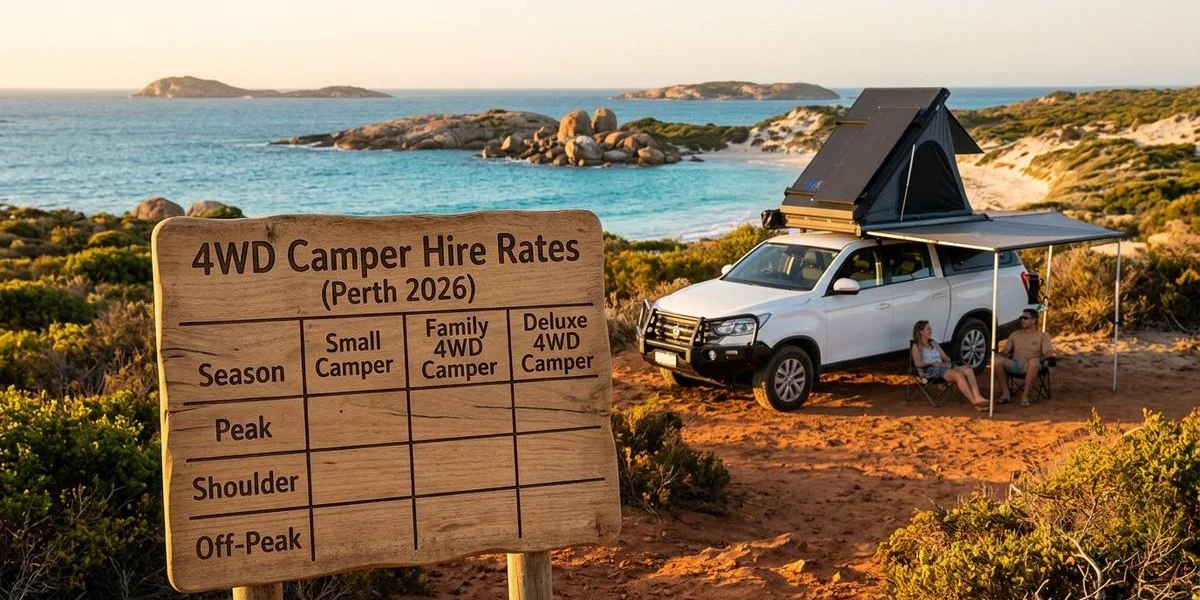
The daily rate is your baseline, but it fluctuates wildly based on supply and demand. For a fully equipped 4WD dual-cab ute (like a Toyota Hilux or Ford Ranger) with a rooftop tent, fridge, and recovery gear, the 2026 market rates in Perth are distinct.
| Season | Typical Daily Rate | Market Context |
|---|---|---|
| Peak (April-October) | $189-$299/day | Dry season in the north. School holidays book out 6-9 months ahead. |
| Shoulder (March, November) | $149-$229/day | Risk of heat or early rains, but significantly cheaper. |
| Off-peak (December-February) | $119-$189/day | Extreme heat in the Pilbara/Kimberley. Best for South West trips. |
These figures assume a standard hire period of 7 to 14 days. Short hires of 3 to 5 days almost always trigger a “short hire surcharge,” which adds 15 to 25 per cent to these daily figures.
Understanding Seasonal Shifts
Peak season in WA is dictated by the weather patterns above the Tropic of Capricorn. The dry season runs from April to October, making it the only safe time to access the Gibb River Road or Bungle Bungles.
We advise booking well before Christmas if you plan to travel during the July school holidays. Availability for these specific weeks vanishes faster than any other time of year. Conversely, if you are heading to Margaret River or Esperance, the “Off-peak” rates in summer offer exceptional value for high-end vehicles.
What Should Be Included in the Rate
A low daily rate often masks a stripped-back vehicle. We believe a “ready-to-go” 4WD hire should include the essentials without charging you itemised fees.
Reputable Perth operators generally include the following in the standard daily rate:
- Sleep System: Rooftop tent with high-density foam mattress, pillows, duvet, and linens.
- Refrigeration: A 40L+ fridge/freezer (brands like Engel or Dometic) powered by a dual battery.
- Kitchen: Two-burner gas stove, 2kg-4kg gas bottle, cast iron or steel cookware, and decent cutlery.
- Shelter: A 270-degree or straight awning for sun and rain protection.
- Furniture: Sturdy camp table and chairs (not the cheap plastic ones).
- Safety Tech: UHF radio for communication on country roads.
- Recovery Gear: Maxtrax (or similar recovery boards), snatch strap, shovel, tyre deflator, and compressor.
- Water Storage: Minimum 20L to 40L capacity, often integrated into the vehicle body.
Hidden “Add-On” Costs to Watch
Some budget operators strip these items out to advertise a lower base rate. We have seen quotes where a fridge adds $35/day and recovery gear adds $15/day.
That simple math changes a $149 rate into a $199 rate instantly. Always ask for the “all-inclusive” price when comparing quotes to ensure you are comparing apples with apples.
Kilometre Charges
This variable causes the most budget blowouts for unsuspecting travellers. Western Australia is vast, and distances accumulate quickly.
There are three common billing models you will encounter:
1. Unlimited Kilometres
This is the gold standard for WA touring. We strongly recommend this option for any trip north of Geraldton. You pay the daily rate and drive as far as required without watching the odometer. A typical Perth to Exmouth return trip is roughly 2,500km before you even do any sightseeing, so this eliminates “distance anxiety.”
2. Daily Caps with Excess Charges
Many companies cap you at 200km or 300km per day. Excess charges typically land between $0.25 and $0.35 per kilometre.
Consider a 14-day trip to the Pilbara covering 4,500km total.
- Allowance: 14 days x 300km = 4,200km.
- Excess: 300km x $0.30 = $90 extra.
3. Total Trip Caps
Some contracts offer a bulk allowance, such as 3,000km for the entire booking. This offers flexibility on long driving days, but you must estimate your route firmly in advance.
Unlimited kilometres is the smartest financial choice for 90% of WA itineraries. The risk of paying hundreds in excess fees at the end of a trip is simply not worth the small upfront saving.
Insurance Costs and Liability
Standard insurance is usually included in the daily rate, but the financial risk sits with you. The standard excess (the amount you pay if damage occurs) is typically $3,000 to $5,000.
Most operators offer “Excess Reduction” tiers to lower this risk:
| Option | Daily Cost | Your Liability (Excess) |
|---|---|---|
| Standard Risk | $0 (Included) | $3,000-$5,000 |
| Mid-Tier | $25-$35/day | $500-$1,500 |
| Max Cover (VIP) | $39-$55/day | $0 (Nil) |
The “Single Vehicle Rollover” Clause
We urge you to read the Product Disclosure Statement (PDS) regarding single-vehicle accidents. Many standard policies exclude cover for single-vehicle rollovers or underbody damage, even if you pay for the highest level of cover.
Driving on corrugated roads like the Gibb River Road carries risks unique to the outback. Verify that your policy explicitly covers:
- Windscreen and tyre damage (one shredded tyre can cost $400+).
- Undercarriage damage from rocks.
- Towing costs from remote locations (which can exceed $1,000).
Bond (Security Deposit)
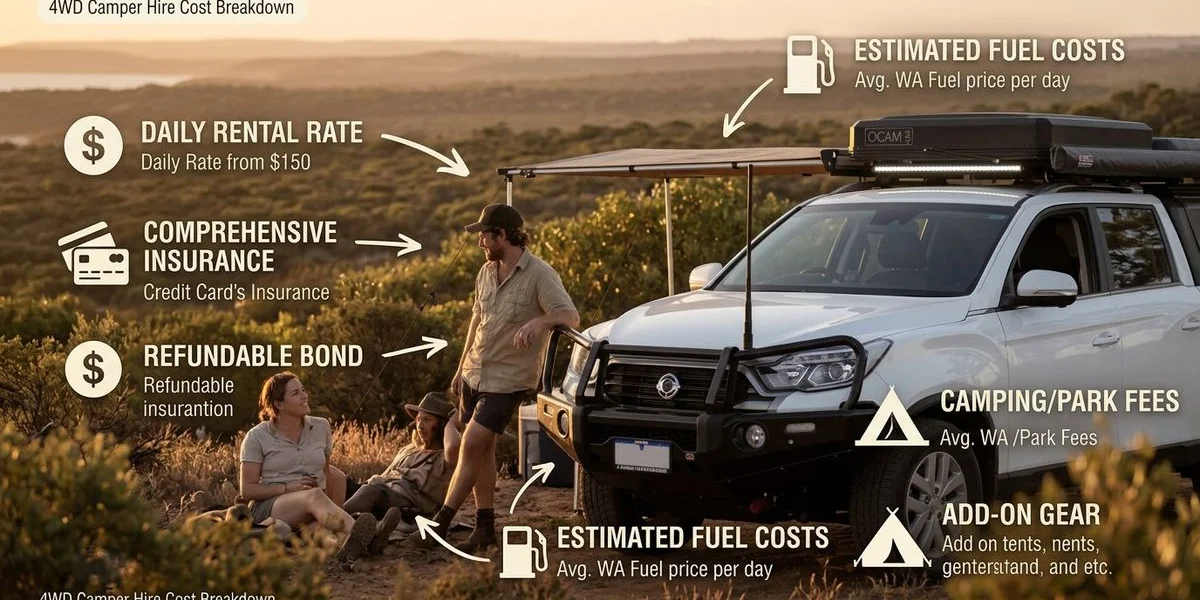
The bond is a pre-authorisation held on your credit card. Operators freeze this amount to cover potential vehicle damage, fuel shortages, or cleaning fees.
Standard bonds in Perth sit between $1,000 and $5,000. We generally release this hold within 3 to 10 business days after the vehicle passes its return inspection.
The Credit Card Surcharge Trap
Be aware of transaction fees on security bonds. If an operator actually charges the bond (rather than a pre-auth) and then refunds it, you might lose the 1.5% to 3% credit card surcharge.
On a $5,000 bond, a non-refundable 2% surcharge is $100 lost. Ask specifically if the bond is a “pre-authorisation” (which usually avoids fees) or a “charge.”
Fuel Costs
Fuel is your second biggest expense after the vehicle hire. Prices in 2026 are projected to remain high, especially in remote zones.
Use the WA Government’s FuelWatch website to track daily pricing.
- Perth Metro: $1.70 - $1.90 per litre
- Geraldton/Kalgoorlie: $1.90 - $2.15 per litre
- Remote Roadhouses (e.g., Mt Barnett, Nanutarra): $2.30 - $2.80+ per litre
Real-World Consumption
A fully loaded 4WD with a rooftop tent has the aerodynamics of a brick. While a factory spec ute might claim 8L/100km, a loaded camper will realistically burn 11L to 13L/100km.
The Math: Over a 3,000km trip averaging 12L/100km, you will use 360 litres. At an average of $2.20/L, budget $792 for diesel. Don’t forget AdBlue for modern diesels; a 10L tank lasts about 5,000km but costs roughly $20-$40 to refill.
Total Cost Example
To give you a realistic benchmark, here is a full costing for a 14-day “Coral Coast” trip in peak season (July 2026).
| Expense Item | Estimated Cost |
|---|---|
| Vehicle Hire (14 days @ $229/day) | $3,206 |
| Excess Reduction (VIP Cover @ $45/day) | $630 |
| Security Bond (Refundable) | $2,000 |
| Diesel (3,000km @ $2.20/L) | ~$792 |
| WA Holiday Park Pass (4 weeks) | $70 |
| Campsite Fees (Mix of stations/parks) | ~$400 |
| Total Trip Cost (Excluding Bond) | ~$5,098 |
This equates to approximately $364 per day for your transport, accommodation, and kitchen.
When you compare this to renting a standard SUV ($100/day) plus motels ($200/night) and eating out ($100/day), the 4WD camper remains a cost-effective way to access the best parts of the state.
How to Get the Best Value
Smart planning can shave hundreds off your total bill. We recommend the following strategies to maximise value:
- Book 6+ Months Ahead: The “Early Bird” rates for 2026 are generally available until December 2025.
- Travel in Shoulder Season: A trip in early May or late September often saves 15% compared to July, with fewer crowds.
- Check for “Long Hire” Discounts: Hires of 21 days or more often attract a 5-10% discount on the daily rate.
- Buy the WA Park Pass Online: The 4-week “Holiday Pass” is much cheaper than paying entry fees at individual parks like Karijini or Cape Range.
If you want a straightforward quote with zero guesswork, get in touch with us. We will provide a single figure that covers the vehicle, the gear, and the kilometres, so you can focus on the map instead of the spreadsheet.
Ready to Start Your Adventure?
Premium 4WD campers from $160/day. Free Perth Airport pickup.
Check Availability